Clay sent the tape to Jenny
Thirteen Reasons WhyClay Jensen’s decision to mail Hannah Baker’s tapes to Jenny Kurtz turns listening into an obligation passed from one person to the next. He returns the package in the form in which it arrived, but with a new name on it; the handoff preserves Hannah’s sequence while making Clay responsible for its continuation.
The Package and the Next Name
At the post office, Clay gives the clerk the shoebox-sized package that had been left on his porch less than a day earlier. He has rewrapped it in a brown paper bag and sealed it with clear packing tape, reproducing the anonymous parcel’s appearance while addressing it to the next person on Hannah’s list. He mutters “Baker’s dozen,” then feels disgusted with himself for noticing the pun: the thirteen-sided structure is not a joke to him, but a burden that has to move on.
The clerk says the package should arrive at Jenny’s address the next day or the day after. Clay imagines Jenny finding it at home, perhaps on the doorstep, perhaps in her room if a family member brings it inside. He remembers his own excitement at receiving a parcel with no return address and imagines that Jenny, too, might wonder whether it is a mistake or a secret admirer’s gift. That anticipation makes the transfer feel doubly cruel: the ordinary suspense of an unexpected package is the same device that first drew Clay into the tapes, but he now knows what waits inside.
Why He Sends It
Clay regrets not waiting until after school and thinks he should have given Jenny one final day of peace, though he also judges that she does not deserve that reprieve. His hesitation does not become a refusal. The package is already in the clerk’s hands, and he leaves without taking a receipt, recognizing that the chain has moved beyond his control.
He briefly considers asking for the receipt back as a reminder. Yet the tapes themselves are not something he wants to hear again, even though Hannah’s voice will remain in his mind. He does not need a paper record to preserve what happened: the houses, streets, and high school associated with the tapes will continue to remind him. Mailing the package therefore closes his immediate custody of the evidence without ending its presence in his life.
What the Chain Carries
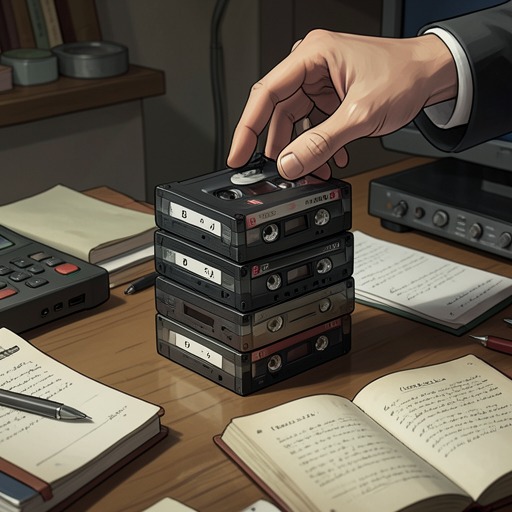
The parcel contains seven audiotapes, with dark-blue numbers marking each side in sequence: one through twelve across the first six tapes, then thirteen on one side of the last tape, whose reverse is unnumbered. Hannah’s instructions make that physical order a rule for the listeners: they are to hear all thirteen sides, rewind the tapes, return them to the box, and pass them to whoever follows. The numbered sides make the chain legible and sequential; forwarding the same box keeps its route intact.
Hannah also warns that she made a copy of the tapes. If the package fails to pass through everyone on the list, those copies will be released publicly. The threat gives Clay’s act a consequence beyond Jenny’s private arrival at the story: sending the tapes onward obeys Hannah’s stated terms and helps keep the material within the chain. His choice is thus neither a simple act of generosity nor a clean escape. It transfers the burden while leaving him with the voice and memories the physical package can carry away but cannot erase.
A Handoff That Does Not End the Story
The novel later identifies Clay as number nine when he removes the fifth tape, marked with a dark-blue nine, from the Walkman. His place in the numbered sequence clarifies the importance of the next-name handoff: the tapes are organized not merely as recordings, but as a route through a succession of listeners. The tape itself continues beyond any single listener’s experience; when one side ends, the cassette clicks over and plays on, while the faint static beneath Hannah’s voice remains audible across the stories.
Clay’s mailing to Jenny extends that structure beyond his own listening. The package leaves his hands, but his knowledge does not. In that contrast lies the action’s defining significance: the chain can move the recordings onward, yet it cannot make the consequences of hearing them disposable.